As many of you know, Better Life has held the Correctional Service Canada (CSC) Faith Community Reintegration Contract (FCRP) for a number of years. Much to Better Life’s surprise, a Florida-based corporation undercut the financial bid of the most recent contract (without providing support in all the designated regions…), and consequently gained a number of the FCRP contracts across Canada, including ours.
While this came a quite a shock—particularly since Better Life has been recognized by CSC as a national leader in faith community reintegration best practices—after many conversations and much prayer, the Better Life team believes our future is as bright as ever.
We recognize this as a moment to reaffirm our identity and sense of mission as an organization.
From the very beginning, Better Life was shaped by what Christians call the gospel. The belief that our identity and very nature can be radically transformed by a Creator God who loves us so deeply He sacrificed Himself on our behalf. As the Gospel of John says so eloquently, “For God so loved the world that He gave His one and only Son that whoever believes in Him shall not perish, but have everlasting life.” (John 3:16)
As Better Life, we believe that the gospel compels us to look at every human as being created in the image of God, and therefore, having dignity and worth—no matter who they are, no matter what they’ve done.
I truly count it a privilege and an honour as Better Life’s executive director to have a front row seat to witness the actions of men and women who love and follow Jesus as they invest themselves in serving the ‘least of these.’
Moving forward, while Better Life no longer holds the CSC FCRP, our team are able to continue to provide faith community reintegration support by meeting with men and women within the Correctional Institutions and assisting them into church communities that provide life-changing and eternity-altering support.
We plan to continue to work closely with our wonderful network of church communities, Correctional Institution Chaplains, Institutional and Community Parole Officers, Halfway Homes, Substance Use Treatment Centres, and our friends through the community reintegration network.
That said, up to this point, Better Life’s funding was largely through the CSC contract, which is no longer the case. While we have reduced our organizational costs as quickly and substantially as we can, the fact is there are still many financial commitments that Better Life needs to continue in order to to facilitate healthy reintegration support.
For instance, some ongoing needs are our toll free number, that allows offenders and parolees to connect with their Better Life chaplain, our online presence that allows us to communicate the stories of transformation provided through church communities, and a reduced level of staffing retained to support the many actions that are need to connect men and women as they gain parole with a church community, and all the other services that are an essential part of a healthy reintegration experience.
In the midst of so many good and worthy requests for your financial support, you may ask, “why should I give to Better Life?”
Why?
Because this often overlooked ministry is a clear expression of Jesus’s ministry and mission. Jesus was clear that a commitment and investment in ‘the least of these’ (including those imprisoned—Matthew 25:39) is a clear expression of a genuine follower of Jesus (No, we don’t invest in the least of these to somehow earn God’s favour. But, as authentic followers of Jesus, our lives are invested in those who Jesus is committed to.)
Because supporting parolees through a church community of people who love and follow Jesus is both life-changing and eternity-altering. What Better Life has experienced over and over again is the transforming power of God through His people and church to give parolees a hope and a future.
Because supporting Parolees through church communities radically impacts our society for good. A former Correctional Service Canada (CSC) Regional Chaplain noted that recidivism (reoffending) drops by over 80% when parolees are reintegrated back into society through their church community.
Can you imagine the impact that has on our society as a whole?! We constantly read headlines about our broken prison system, the terrible consequences of untreated substance use and mental health, not to mention horrible examples of reoffending.
But what church community reintegration shows us is that when a man or woman with a criminal past is welcomed, supported, discipled, counselled, provided opportunities for employment and education, transformation is possible, and that individual can again become a contributing member of our Canadian society.
In our next Better Life post, I want to share one of the amazing stories of transformation with you. But for now, for the reasons listed above, would you consider an investment into the ministry of Better Life as together we join Jesus in His mission of ‘setting the prisoner free.’
As Better Life has worked together with faith communities across the Pacific Region, we hear many different responses to the invitation to provide reintegration support.
Some faith communities and their members feel that providing reintegration support is an important expression of their faith. They’re all in, and they want to provide support as effectively as possible.
Others respond with desire to get involved, but feel overwhelmed by questions.
Our hope at Better Life is that having clarity around a REINTEGRATION STRUCTURE AND SYSTEM answers many of your questions and gives you confidence that you can help develop a healthy reintegration pathway that can literally be life changing for a parolee and an invaluable contribution toward them experiencing a better life.
However, we recognize that Structures and Systems only take us so far.
We experience this in our own life. At times we have great aspirations, sometimes expressed in New Year’s resolution. But living out our resolutions can be another thing entirely.
This leads us to acknowledge that we’re all individuals who are made up of many different influences—our families, our experiences, and our habits, to name a few.
What type of influence has each of these areas had on our life?
As human beings, we each respond to varied circumstances in different ways. Specifically, we experience and are impacted by trauma in very different ways.
In your own family, your experience growing up may have impacted you in a radically different way than a sibling. You could have experienced very similar circumstances, but how you experienced those circumstances and integrated them may have been very different for each of you.
The same is true for a parolee.
You’ve listened to their story, you’ve created a pathway together that you hope will lead to a healthy reintegration experience, but so much of an individual’s experience, their growth, their ability to overcome painful experiences and trauma, and to believe that they can live a different and better life, rests with them.
With this understanding, we want to assure you that not only is Better Life made up of an experienced team of Reintegration Chaplains, but that we are a part of an invaluable network of organizations and caregivers committed to healthy reintegration.
The Better Life Reintegration Chaplain who, in many cases, has provided an inmate support for a year within the prison, who has worked with the inmate’s Correctional Team and has supported them to complete the recommended steps so that they can have a positive parole hearing outcome, is now available to support you as you support that parolee.
While the Better Life reintegration chaplain doesn’t remove their support from the inmate as they enter parole, they shift their primary support to you as a caregiver.
When you have questions, when you wonder what healthy next steps should be, when you’re concerned about certain patterns of thinking, or behaviour, and wonder what to do next, the Better Life Reintegration chaplain is available to provide you with support.
This is also true of the connections Better Life can provide you with various reintegration partners—often beginning with the parolee’s Parole Officer. Through the Parole Officer you can gain a clear understanding of what the parolee’s conditions are, as well as specific areas that may need attention (work, education, therapy, certain thought patterns, etc.)
Beyond a connection with a parolee’s Parole Officer, Better Life has close relationships with many Reintegration Partners operating in various regions and areas of specialization.
At Better Life we are here to support you. We believe that you can make a life changing difference in providing reintegration support, and we want to support you to do that effectively.
Thank you for joining us for this series on providing healthy reintegration. We’re grateful to be on this journey with you.
In the current Better Life Integration and Support series, we’re looking at the ingredients of healthy reintegration.
In the previous edition, we addressed the importance of mentors and volunteers understanding the Reintegration Structure.
We picture this Structure as a bridge that begins in the Correctional Institution and extends into the community. We envision the four essential components of the bridge as the support, the onramp, the main body of the bridge, and the offramp or exit. Each one of these stages requires specific types of support.
In this edition, we will look at SYSTEM. In other words, what works within the STRUCTURE of Reintegration to make the process function effectively?
Specifically, what can a mentor, volunteer, and community of faith provide to help a parolee have a healthy reintegration experience and move towards becoming a contributing member of their society?
At Better Life, we believe that a clear and healthy pathway can be created to support the the best possible outcomes for an individual’s reintegration.
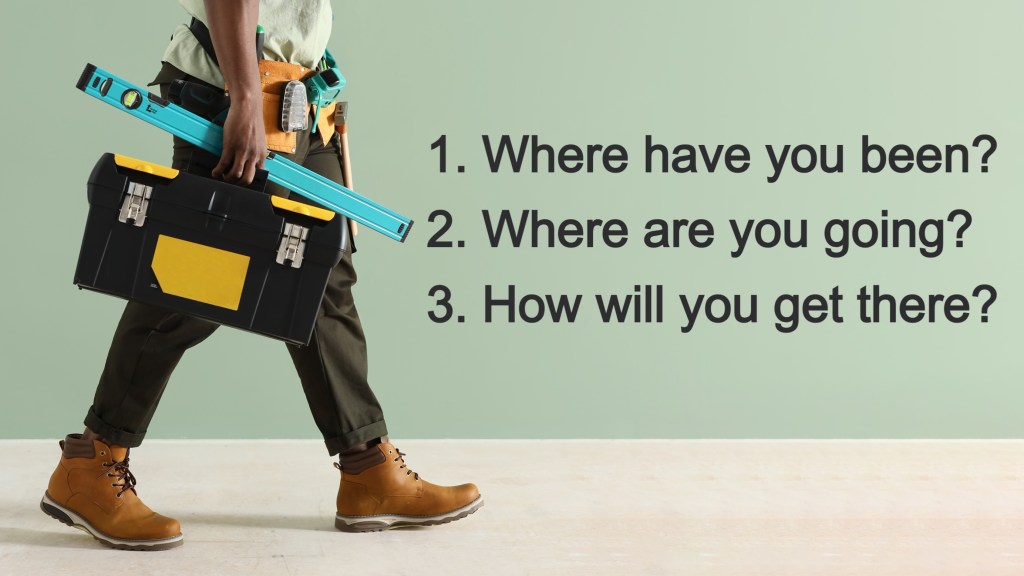
We’d like to suggest a System that develops through three invaluable questions.
Let me underline that these questions are ones you can ask in conversation together with the parolee during the first month of parole.
In other words, everything that you and the parolee experience together is a product of developing a trusting relationship, which the reintegration pathway is built on.
So let me encourage you—don’t feel like you have to rush. Let the relationship develop, and out of the relationship, ask these three questions that allow a pathway to be created.
This is such an invaluable question. It’s obvious that a parolee has been places that have had a serious impact on their life.
It’s a question that addresses their crime, and in relationship to their crime, the conditions that they now have for their parole.
It’s also a question that address an individual’s challenges in life. For instance, a therapist once asked a group of men in a high security prison how many of them dreamed as little boys that they would be in the place where they are now? Of course, not one of them raised their hand. No one dreams of being incarcerated as a young boy, or young girl.
What we know is that a parolee has had certain experiences and responded to those experiences in a way that wasn’t healthy, wasn’t contributing to society.
On one hand, we don’t enter the work of providing reintegration support as a therapist, a psychologist, or psychiatrist. It’s not our role to provide professional therapy. But knowing a person’s story not only makes a caregiver aware of the comprehensive help that a parolee needs, but also recognizes the importance and supports the fundamental and life-giving experience of being known.
To emphasize this point, a parolee may not believe this is true. They may experience shame, or guilt and may have had their desire for secrecy reinforced over and over again within the context of a prison. Sharing their past may not come easily. However, we understand that hiddenness and secrecy do not bring about healing and growth into our life.
Our starting point on the road to a healthy reintegration is a person’s story.
Listening to their story (not judging or questioning, but listening), communicates the value you place on them and the care you desire to give them. The details of an individual’s story may come out over time, but as trust is built, this will be the outcome.
Before we move onto the second question, let me circle back to the connection between a parolee’s story and their conditions of parole. This is important because the most often asked questions by faith communities are, “Will we be safe? Will our community be safe? Will our children be safe?”
In response, there are a number of conditions that a parolee must follow.Some conditions are general and will apply to all parolees, and some are very specific, depending on the parolee’s crimes.
For instance, an individual who has had a sexually related offence, or an offence against a minor, will have very clear conditions restricting them from settings where there are minors present.
So, in summary, through a parolee’s story, we also learn of their parole conditions and supervision and can understand how best to provide safety for our faith community and for the offender. (Parole conditions also will be proactively shared with the faith community representative supporting reintegration.)
Through listening to the parolee’s story and offering support we begin the journey of providing a trusted relationship foundation that healthy reintegration is build upon.
The importance of this question may not be so obvious.
But a Better Life board member, a criminal law lawyer, puts the question into perspective like this:
What would it be like for you to be judged every day of your life for the worst day or moment of your life?
It’s hard to even envision, isn’t it?
What the question illustrates are the challenges that a criminal history and incarceration bring.
For instance, one ‘lifer’ who went on to experience faith and become a prison chaplain himself, tells of his experience on the day that he was released for parole. The prison guard looked at him and said, “See you back soon!”
Often this is the sentiment communicated. It’s informed by the way many inmates become institutionalized, and can sometimes begin to feel it’s easier to stay incarcerated than to face the many challenges reintegrating back into the community will bring.
As we ask a parolee the question “Where are you going?”, we are inviting the parolee into the experience of envisioning their life in a new way.
A way that is often impacted by the hope of their faith, and how their faith practices can allow them to see both themselves, and life around them in a new way. In many respects, this is one of the most important areas of support a caregiver can provide.
While the diversity of faith beliefs envision hope, love, forgiveness, grace differently, I was impacted through my conversation with an Imam who asked, “Adam, how can we hold an individual’s past and crime over them for the rest of their life, when God tells us that he forgives those who earnestly repent? If God can forgive, why don’t we?”
Again, there are distinctions between the many different faiths, but the Imam’s question was an important one to answer and have clarity on for any caregiver who is providing reintegration support.
We could ask, and answer, what elements of my faith can enable the parolee I’m working with to both envision and experience a life of forgiveness and contribution within our faith tradition?
In many respects the answer to this question will be informed by the parolee’s answer to question number one, Where Have You Been?
Through listening to the parolee’s story certain elements, specific needs, come to light.
It may be, on one hand, that the parolee is very mature in their faith. In fact, they may be at a place in their faith that they can provide support and help for others. We have seen numerous parolees use their incarceration as a ‘wake up call,’ where they either come to faith, or become serious/committed in their faith.
There are also Prison Chaplains who do an amazing job of helping inmates grow in their faith so that they are actually more mature in their faith practices when they reach parole than many in their faith community. In other words, we shouldn’t assume that all parolees are in need of others to teach and train them.
On the other hand, most, if not all faiths, recognize that we ‘never arrive.’ There is always a deeper experience of our faith that we can enter into.
Again, this is why the first question, ‘Where have you Been’ is so important. Through your conversation with a parolee, you will recognize the level of experience they have had in their faith practices and engagement, and whether or not they are in need of professional therapy, or education, or housing, etc. Their story, their needs, their path forward will be distinct and unique to them.
Better Life’s recommendation is that through the first month, or even first quarter of relationship building, you create and make an agreement of what the next period of time together will look like.
For instance, you may agree to a six month period of studying or practicing an element of your faith together.
The agreement may also include intentional conversations about other critical areas. Perhaps, the parolee is also undergoing addiction treatment, or mental healthy therapy, for instance. A part of your regular time together may be to incorporate space to talk about how they are feeling as they address their challenges of addiction.
You’re not engaging with the parolee as a therapist, but you are giving opportunity for them to talk about their experience.
What we call a Commitment of Trust Agreement can be invaluable because it specifies healthy relationship boundaries, the expected frequency of meeting, the duration of support (e.g., We will meet for six months and then we will evaluate), and even what you will focus on in your time together.
As an example, the invaluable organization (CoSA – Circles of Support and Accountability) uses a very similar agreement that is phenomenally effective in reducing recidivism (reoffending) with parolees who have a sexual offence history.
What Better Life has discovered is that the benefit of a parolee engaging in the practices of their faith community—prayers, services, etc.—are enormous. Many faith communities are welcoming and supportive to parolees attending their community.
However, what often provides the highest impact is the individual’s experience of relationship. This may be in the context of a member of the faith community regularly meeting with the parolee for coffee and conversation. It may be inviting the parolee into a small group that engages in providing support together, or having the parolee experience an existing small group as a means of experiencing healthy relationship.
Let me encourage you, use these three questions like tools in your tool box to help you provide support that leads to a parolee’s healthy reintegration.
2023 has been a year of growth and development for Better Life Integration and Support as we continue to refine our process for providing a healthy reintegration experience for offenders and parolees who ask for faith community reintegration.
While Better Life recognizes that each individual is unique (has a distinct story and experience), we also understand that healthy reintegration requires specific structure, system, and support.
In fact, this past summer (2023), we developed a new set of Faith Community Reintegration videos for individuals and faith communities providing reintegration support to access online. These short videos are built around:
Reintegration Structure
Reintegration System
Reintegration Support
To access this free online training resource, please email adam.betterlife@gmail.com for the link and password.
Over the next three blogs/newsletters, we’ll also look in more detail at the three components of healthy reintegration, as outlined above.
We begin with having a clear understanding of Reintegration Structure.
We picture Reintegration Structure as a Bridge. In fact, you’ll often hear us refer to the “Reintegration Bridge.”
The Reintegration Bridge is composed of four parts:
The Support holds the weight and stress of the bridge
The Onramp is where the bridge is entered
The main Body of the bridge
The Offramp is the exit from the bridge
1. The SUPPORT
We all recognize how essential support is for a (structural) bridge. Comprehensive support is just as essential for Reintegration, and not just in the sense of providing support to the parolee, but also in giving a mentor or volunteer the capacity and strength to provide reintegration support.
On one hand, providing reintegration support isn’t for the faint of heart. Every experience of providing support is unique, ranging from parolees that need intensive support, to those who require little support, but the experience can often be intense.
At the same time, there is such an opportunity for mentors and volunteers of faith to experience life transformation, both in themselves and in the individual they are supporting.
As you consider providing reintegration support, you can ask yourself the following questions:
How would you rate yourself in terms of your personal health, your emotional health, your relational health, your self-awareness?
How clear is your practice of personal boundaries? (If you’re unclear about the idea of boundaries, Drs. Cloud and Townsend wrote an excellent book on boundaries.)
Where do you get your support from?
How do your faith and faith practices provide you with clarity and strength when you are investing in others?
Of course these aren’t questions solely for providing reintegration support, but healthy life principles for each of us.
As you invest yourself in providing reintegration support, you need to be clear on where you gain your support to enable you to support another. As you enter into providing reintegration support, have a plan of what you are proactively doing so that you are and remain healthy.
Identify the people you can go to if you are feeling challenged, or discouraged, or in need of direction. It may be a group of close friends, a spiritual leader, or mentor from your faith community. We encourage you to identify those people in your life that can support you and pray for you as you begin this journey.
Without question, the experience of providing a parolee with reintegration support can be one of the greatest opportunities for you to grow in your own spiritual life.
2. The ONRAMP
The Onramp is well defined for Better Life. It illustrates what is normally a period of up to 12 months where support is offered to an offender in the Correctional Institution.
An inmate contacts Better Life, either through a prison chaplain, through their Institutional Parole Officer, or personally through the Better Life toll free number.
A Better Life staff member dedicated to that inmate’s specific prison meets with them and undertakes an intake interview.
During the interview there are specific questions that we ask, but in general, we are seeking to understand an inmate’s motivation and the degree of interest they have in seeking reintegration support from a faith community.
One of Better Life’s non-negotiables is the willingness of an inmate to provide full disclosure.
We take a faith community’s trust very seriously, and therefore, view an inmate’s willingness to provide full disclosure an essential for their healthy reintegration experience and for the potential of their relationship with the faith community, mentors and volunteers.
What’s significant for mentors and volunteers to understand is during that 12 month period, a Better Life staff member is working closely with the inmate to develop a relationship of trust with them, to understand their correctional management plan and team, and to begin building a connection with a potential faith community for when they achieve a positive parole hearing outcome.
The relationship of trust between the inmate and the Better Life staff member is invaluable for the faith community to understand the needs of the inmate and the faith community’s potential to support them.
3. The BODY of the Bridge
Best practice in healthy reintegration is, as an inmate enters into parole, they are quickly connected with their supportive faith community. This connection may have already been established while the inmate was within the Correctional Institution.
Better Life’s practice is that the week an individual enters parole, if not the day of, the parolee is introduced to a representative of their respective faith community.
At times, the individual’s community parole officer may request to be included in this meeting.
During the initial meeting the parolee will share their story. A Parolee’s willingness to share their story helps to ensure their safety and the safety of the faith community as well, and begins to create a healthy reintegration pathway.
The initial meeting is also an opportunity for the faith community representative to talk about the ways a parolee can access the community and experience their support.
While each of the four stages of the Reintegration Bridge are important, the contribution of Stage Three is invaluable. It is in and through the faith community that a parolee experiences:
The opportunity to experience trusted relationship(s)
Engagement in empowering faith practices
Support for the tangible needs that a parolee may have, including:
Employment
Housing
Education
Therapy, which may address areas of Trauma, Addiction and Mental Health
4. The OFFRAMP
The goal of reintegration is a healthy reintegration experience, with the ultimate outcome that a parolee becomes a contributing member of society.
However, it’s important to recognize that healthy reintegration isn’t always linear.
In other words, reintegration support doesn’t guarantee that the parolee will never again experience challenges with addiction, or mental health, certain temptations or unhealthy behaviours.
A Parolee’s experiences along the reintegration pathway are always informing those that provide support with a clearer picture of what is going to help the parolee move forward in their reintegration.
For instance, an offender enters parole and is provided with reintegration support by loving, wise caregivers. But the offender cannot overcome the temptations of their addiction, and by giving into their addiction, has parole revoked because they breached their conditions.
It may be easy to believe that the caregivers failed to provide healthy reintegration support. However, instead of a sense of failure, such experiences are invaluable in helping provide a more holistic, comprehensive pathway for the parolee.
The parolee’s challenges with addiction, or any challenges for that matter, alert us to the specifics of what the individual needs to move forward.
For example:
For an individual that struggles with challenges with alcohol or drug addiction, the new plan will include the individual going into addiction treatment.
For those who are challenged by sexual addiction, the new plan will include becoming a member of a CoSA group that specifically provides structure and accountability for sexual addiction.
For those who are overwhelmed by trauma, or are challenged by other issues of mental health/illness, the new plan will include being under the care of a therapist, or a psychiatrist, if medication is required for treatment.
The point is, we use the awareness that comes from the parolee’s experience to inform what a healthy reintegration pathway will look like for the individual.
In conclusion, the support and development of trusted relationships that come from members of a parolee’s faith community are invaluable for their healthy reintegration.
While a parolee’s reintegration may not always be linear, the development of trusted relationships with faith community caregivers can be life changing.
In the next Better Life Newsletter we will look at the importance of having a clear REINTEGRATION SYSTEM.
Recently a new friend asked me what I did for a living.
I began to tell him about the vital work of community reintegration. His response? “Good luck with that!”
Frankly, I wasn’t surprised—and perhaps you’ve had similar responses as well.
Hardly a week goes by without national or provincial news about a high-profile offender who has reoffended. Such headlines persuade us there is no hope for a healthy reintegration experience.
Thankfully, this couldn’t be further from the truth.
While the work of reintegration can be very complex, in general, the high-profile cases that capture news headlines are more often than not a result of an offender leaving a correctional institution with no meaningful, comprehensive support.
We know that healthy reintegration becomes possible when we can help offenders into the ‘relational resource centre’ of their church or faith community.
When healthy relationships of trust are established and modelled, when accountability is nurtured, and when resources such as employment, therapy, addiction treatment and housing are made available, a parolee begins to gain one of the invaluable qualities of life: hope.
And what we are discovering is, when a parolee does re-offend, the re-offence is typically less severe than previous offences. Further, that situation becomes an opportunity to focus our relationships and resources more closely on and around the specific challenges that parolee is wrestling with.
Does faith community reintegration work for every offender?
Full disclosure: yes . . . and no.
Yes, because:
Every dimension of support that ‘we’ (the Better Life Team and all the amazing churches and faith communities, mentors, and volunteers) can offer impacts a parolee’s life for the better, and often for eternity.
Just this spring, LS entered parole. Because of the nature of his crime, he couldn’t go back to his former occupation. But LS was willing to begin again at the bottom. He recognized his need for the support of his church community.
Recently, a Better Life Team member and I met with LS. He shared examples of his growing faith and his desire to serve in his church in the area God has gifted him (to give back).
He spoke about Integrity: The Courage to Meet the Demands of Reality, an excellent book by Dr. Henry Cloud that LS’s Better Life reintegration partner had given him before he was released on parole, and how he is applying its principles in his life each day.
He talked about how, while humbly being willing to ‘begin at the bottom,’ he was now being given the opportunity to provide site management and the promise of greater advancement in the future in his new field.
The story of LS’s life is being written, or perhaps ‘rewritten,’ in such a redemptive way.
Another recent example is CM.
On the day of CM’s release, the Better Life reintegration partner, who had been supporting him while he was still inside, and I accompanied him to a church within a close distance from his halfway home.
CM told the pastor his story and the pastor welcomed CM into his community and talked with him about the ways that he could experience meaningful relationships and support at the church. A pathway for healthy reintegration was created for CM to travel on.
So, where does the ‘No’ come in? When doesn’t faith community reintegration work?
Really, the only time faith community reintegration can’t ‘work’ is when there’s no church or faith community available to reintegrate the individual into.
And that, in a nutshell, is the challenge.
Our hope, our prayer, and our commitment as Better Life is to have trained, equipped and supported churches and faith communities throughout the Pacific Region that are ready to welcome and support a parolee through their community reintegration.
We are continually meeting with and providing training for churches and faith communities, but we need so many more.
And, certainly for Christians, our faith compels us directly from the words of Jesus to invest in the ‘least of these.’ (Matthew 25)
On this Giving Tuesday*, I would like to ask you to consider responding in two ways:
First, are you a part of a church or faith community that Better Life could meet with and help train and resource as a welcoming and supportive community for healthy reintegration? Email adam.betterlife@gmail.comto start the conversation.
Your financial contribution will enable Better Life to continue to provide training, resourcing and support to church and faith communities so that their doors are opened and their mentors and volunteers are prepared to provide a life-changing experience for a parolee.
With thanks,
Adam Wiggins
Executive Director
*”GivingTuesday is a global generosity movement unleashing the power of people and organizations to transform their communities and the world. GivingTuesday was founded in 2013 in Canada by CanadaHelps.org, GIV3 and several other founding partners.”—from GivingTuesday.org
I recently attended a commencement ceremony at Kinghaven Treatment Center. One of the men graduating from the program had asked for Better Life support and to be reintegrated into a church community. Frankly, I wasn’t sure what to expect. However, I was blown away!
Four men stood up to share their stories and spoke about the people, the program, and the relationships.
As I listened to men tell about their experiences and friends and family share their words of support, I couldn’t help but think this was a picture of healthy reintegration! This was what every offender desperately needed for healthy reintegration. It was powerful!
And it was a picture of why Better Life and the entire reintegration network is so committed to placing parolees into supportive faith communities where the experience and modelling of healthy relationships, needed resources, and faith practices can have a game-changing/life-changing impact on an offender.
The stories at the ceremony also highlighted that a very high percentage of offenders wrestle with issues of mental illness, including post-traumatic stress disorder (PTSD) and addiction. What may come as a surprise is, far too often, addiction treatment and mental health are left unaddressed as an offender moves from a Correctional Institution to parole.
It’s heartbreaking that, when the challenges of addiction and mental illness are left unaddressed, the probability of reoffending is extremely high, even when we place the affected individual into a faith community.
As these challenges become more obvious to Better Life, we have renewed our commitment to advocating for the men and women we support so that both addiction and mental health needs are taken seriously and addressed. We will continue to advocate for those who are challenged by addiction to go into treatment before they are reintegrated back into the community so that they have the best opportunity to experience a healthy reintegration and become a contributing member of their community.
As we think about the issues of addiction treatment and therapy for mental health issues, we were recently able to send DG to a very specific type of therapy for PTSD. DG’s experience shows how valuable therapy can be for reintegration.
DG writes:
Eye Movement Desensitization and Reprocessing Therapy (EMDR) has gained in popularity over the past 20 years and is quickly becoming an accepted method of treatment for people experiencing symptoms related to Post Traumatic Stress Syndrome (PTSD), or those who have experienced some form of trauma in their past. Rest assured, there is no shame in attempting to resolve something so impactful upon your quality of life.
The treatment is primarily accomplished via ‘talk therapy,’ with the added component of guided eye movement. This serves to ‘reprogram’ how the brain interprets and responds to some of life’s many challenges. This therapy can be quite intense for a person and one would be well-advised to allow time to decompress, post-session. The number of sessions required depends upon the depth of the issue being targeted and one’s receptiveness to the designed therapy.
For my part, while working with a Social Worker some time ago, I raised an issue I was having for discussion. For the longest time, I’d been getting irritated quite frequently—while in my bedroom, awake or asleep—and eventually realized that the sound of my door—any door, being opened or closed—was responsible for eliciting such a strong emotional response. At times, I would feel my entire body tense, becoming hyper-alert. Still others, I would instantaneously become disproportionately angry.
I’ve never doubted that one of the many consequences of serving a lengthy prison sentence is PTSD. Frankly, I am of the opinion that anyone, man or woman, is likely to experience symptoms of PTSD after serving only a year or two behind bars; in some cases, even less! Inexplicably, this issue with doors did not manifest itself fully until I was in the community. Moreover, I have since spoken with a number of CSC staff, who admit to similar psychological and physiological responses.
Though one may think that witnessing violence with some frequency, would be the impetus to symptoms of PTSD, there are numerous less obvious causes which can be equally devastating to the human psyche. Therefore, I would encourage anyone reading this to be open to the possibility of deeper, residual, and unchecked effects of incarceration. At the very least, talk to someone about this. They are likely to bring a more objective view to the situation. Doing nothing about these responses only negatively impacts a person’s quality of life, as well as increases the risk of future problems, which may very well lead back to life in prison. That choice rests with you!
In conclusion, let me add that this is the longest DG has gone without reoffending.
What’s made the difference? As he concludes, That (the) choice rests with you! That’s always, and ultimately, true for each of us. BUT, alongside that choice, when we can provide the people and the resources to welcome and support parolees in the context of a faith community, it truly changes the outcome of a person’s life.
With that in mind, please accept my heartfelt thanks. Thanks for investing in the “least of these,” as Jesus referred to the marginalized in our society. Your investment impacts a life, a community, and ultimately an entire nation!
As you may know, the support that the Better Life Team offers to offenders is managed and funded through something called an “FCRP (Faith Community Reintegration Project) contract.”
Over a year ago that contract term ended and “came up for bid”—in other words, we (and any other interested parties) needed to put in proposals for the contract going forward.
Better Life duly submitted a proposal . . . and waited, and waited, and waited! In fact, we had to submit a second proposal at the end of 2021 because of ambiguous language in the original Request for Proposal (RFP) that invalidated the process. Thankfully, we were able to keep operating without interruption under temporary contract extensions for the duration.
Well…it’s a pleasure for me to announce that Better Life was again awarded the FCRP contract!
The current government contract now extends into the Spring of 2024. This means that we can continue to invest in providing the invaluable support required for healthy reintegration.
We always say at Better Life that our commitment is to support the men and women who are in, and are coming out of, Corrections. However, as a Correctional Service Canada contractor, we have access to the prisons and halfway homes beyond that granted to a purely volunteer-based organization. This has truly been a gift through the pandemic, in particular.
The value of what Better Life does was reinforced to me recently as a brand new parolee, CI, was welcomed into his halfway house in Surrey.
CI’s Better Life Team support chaplain, Glenn, and I visited to be introduced to the new manager of CI’s halfway house and then we drove CI to a nearby church that Better Life has begun a partnership with (we provide the church and its mentors and volunteers with training and support.)
I listened as CI told the pastor his story. A story that includes being released from prison previously, but with no community support. CI had breached the conditions of his parole and was sent back into prison, where he met Glenn—and through Glenn, recognized Jesus, and surrendered his life to Him.
As CI met with the pastor, he talked about the strength that his faith now gives him—but also, how he would not be connecting with this church on his own, or at the very least how much more difficult and intimidating it would be.
Instead, there we all were! CI, the pastor of the church, Glenn and myself talking about the intentional steps that CI can take to experience the strength and support of a church to help him continue to grow in his relationship with Jesus and to experience a very different direction for his life.
I realize that many of you that we connect with through this Better Life Blog are members of faith communities that provide support for parolees. We’re grateful for you!
If your faith community doesn’t yet have access to Better Life’s online training, which we are continuing to develop, please email me at adam.betterlife@gmail.com and I would be happy to provide it for you.
I wish I could have brought each of you to the Christmas celebration hosted by one of our Chilliwack-area team members and his wife.
What was so impactful was that, after an incredible meal, we had a time of sharing. Each of the men who had received Better Life support spoke about how it has been a life-changer for them.
In fact, men were phoning into the event because they wanted to share their stories and express their gratitude for the support they had received.
As I prepare online reintegration training for our faith communities, I recognize how complex the work of reintegration can be. There are many important details that need to be kept in mind.
However, at times, I’m overwhelmed by the simplicity. As I listened to men share stories about how their lives had been impacted through the support of a Better Life team member, what was mentioned most of all was the consistency: “You were there for me.” “You kept showing up.” “Your actions convinced me that you cared and that, because you cared, I mattered.”
As the larger Better Life community, let me say thank you.
I am deeply grateful for your support and for how investing in ‘the least of these’ can make an invaluable difference in supporting offenders to become valued and contributing members of our society.
Thank you for joining us in our mission of “Eradicating Recidivism, one life at a time.”
Merry Christmas and all God’s best to you and yours for 2022!
Adam Wiggins
General Director
Message from the Better Life Integration & Support Society Board of Directors
This has been a challenging year for our Society, yet we have continued to see wonderful results as men and women are being integrated back into our communities successfully.
This success has been due to the staff and volunteers that God has led into this ministry. Everyone has been used mightily in this work.
We would especially like to thank Adam Wiggins, our General Director, who has been inspired in his work with the Society. He took over at a critical time and has led us through some difficult and frustrating times. In spite of these challenges, Better Life has continued to grow in size and impact.
One specific challenge has been the delays in our bid to reacquire our current contract with the Correctional Service of Canada. This contract is our greatest source of funding and also gives us access to the bulk of our contact with inmates in federal custody.
The delay in our bid being assessed has hampered our ability to develop the necessary initiatives to be better equipped and to stabilize our resources into the future. Our existing contract was extended time and time again with no increase in our revenue and with no indication of the final decision. We recently were notified that no one was awarded the contract and that another submission will be required.
Please pray that the new bid, currently being prepared, will be successful and that our resources will continue to grow.
To all our staff and volunteers, may God bless you and your families. Thank you for your dedication and efforts in assisting the marginalized groups we support.
Merry Christmas and may you have a Happy and Rewarding New Year.
Today we’re bringing you the remarkable first chapter of Astrid’s story, written six years into her reintegration process in Germany:
Getting released from Fraser Valley Institution for Women almost six years ago felt like kind of being reborn.
Being on the inside, I never felt I had been held captive in darkness and now was going to see and be blinded by the light, not at all. I had just simply gotten used to this artificial security. After 12 years, inside became a safe place. I had found solace in knowing the ropes.
This truth was revealed one morning, in my ninth year, when my superficial greeting of “How are you?” to another woman got a sarcastic, “Oh couldn’t be better, I am living my dream!” in response.
Sure, no one finding themselves inside the barbwire is living their dream, but to me, at that moment in time, it felt I was.
How could that be? I had found what I couldn’t in this big wide world outside of the fence; a place I felt secure, a place that did feel like home. Inside, away from the luring haste of life, I came to moments of being home in this temple, my body, in which God lives.
Meeting the parole board in September 2015, I had the chance of release—and with release, a ticket to freedom to a country I had not lived in almost 20 years, where I would not be supervised by any governmental body.
I was not anticipating this day with joy and excitement, but rather with fear. Fear of giving up my safe place. Life on the inside for the past 12 years had come easy to me, ever since the first serious advice from the Institutional Parole Officer: “You are not here to make friends!”
As a woman in her mid-thirties with a past of broken and troubled relationships, not knowing what a healthy relationship was or could feel like, I was only relieved not to have to engage in any of it anymore. This was the first big relief. Keeping to myself made flying under the radar in jail easy and not having to be with others left time for me to be with me.
Prior to committing murder, I led a highly functional lifestyle. I was drug and alcohol-free, but unaware of having been caught up in the addiction of codependency and busyness to avoid being human.
Being far away from God and myself led me to go astray not only spiritually, but also emotionally and mentally. I ended up spiralling in a vicious cycle of taking flight in suicidal thoughts that ended in committing murder. A truth so hurtful and so shameful.
WHY?! This one word, this one question was the only word left to mutter in my heart and my head. Why did I rebel against God? Did I want to prove to God that I was unlovable??
There was no reprieve, nor answers in psychology reports. The “whys” and “how coulds” just echoed inside my head, mingling with labels and confusion.
“Be still and know that I am God.” (Psalm 46:10)
That first hour inside a dark holding cell, stillness spoke love to me in a whisper so gentle and soothing that I felt held, not by walls I could not see, but by a divine strength. Years later I found out that is the meaning of the name given to me by my parents, Astrid, “divine strength.”
Twelve years later, having been held by God’s grace like a fledgling in a nest, it was too scary to face freedom in a country I had not lived in for twenty years and meet my family who I had hurt. But God made clear it was time to fly and fly towards home.
Facing my family was hard, and after so many years I felt so divided. The longing to belong was greater than ever, but with the pain I had inflicted, I felt our distance had grown and acceptance was unreachable. I knew and felt that they could not be there for me and that I had become a burden. This was nothing new to me. I had felt and known this before. Once again, I had to look out for myself, or so I believed.
As a baby I had been received by a midwife. Now at age 47 I was praying to God for a mid-sister. Grace stepped in a wondrous way into this role—unexpected! Just like God does it—creatively and with perfect timing.
I met Grace in the summer, three months before my parole board hearing. She stepped in as chaplain because our chaplain had gone on vacation. Grace led the worship service for us women inside and she approached me after conducting the service. She recognized my accent, as her husband is German. So, we connected and whenever she came in, we chatted about our experiences living in Germany. She shared her joy in raising three children, then teenagers, in two cultures, while I shared my concerns in returning to a culture I felt detached from and a family past I did not know how to engage in, yet nevertheless needed to mend.
Not only did God provide Grace for me to go home to my home country with (strange coincidence or God’s plan, but we both arrived back in Germany around the same time), but God revealed himself in the welcoming hugs and the gift of home. A dear friend from school and her husband picked me up from the airport and received me back into this society that I feared. They delivered me to the town of Celle, a town I had never lived in; a town of civil servants, home to three courts and one jail for men, but also a town where the Christian restorative ministry of the Schwarze Kreuz (“Black Cross”) had its office.
This ministry had vouched for me in the reintegration process. Making an exception, they offered me their little guest room, the size of the prison cell, helped me with bureaucratic processes, in meeting volunteers, in settling, and they gave me time to make independent steps towards finding my own place and work.
After six months, I found work in the field I had been trained in 25 years earlier. After nine months, I found an apartment in a timbered framed house from the 1600s in the middle of the dainty and ancient town center. Nine months after starting work as a furniture maker in a shop, I felt relieved in getting laid-off. My mental state had deteriorated under ongoing fear and anxiety, making concentrated working impossible. The employment counsellor was kind and patient, realizing I was putting too much pressure on myself with unrealistic expectations.
I was held back from applying for jobs, but he offered me a work program called a “1 Euro Job.” Literally, for each hour of work, I earned one Euro. Since I had not picked up on the negative stigma that this program held, I went for it like a relieved greenhorn and I got sent to the church just around the corner from where I lived. I sought out the sexton of that church and was put to work 20 hours a week in assisting the sexton in cleaning and maintenance work. For two years I was on social assistance working at a 1 Euro Job while growing in Christ and building relationships.
During the years inside, I had not missed much from this free world, but I had missed hearing live music in real life time and space. While hanging out in front of the radio listening to CBC Radio Two, I repeatedly prayed “God, please let me hear music again, real music in the moment of time where it is been created.”
This longing was fulfilled on the second day of my 1 Euro Job. It was early morning prior to the church opening. I was cleaning the empty sanctuary when the music director came in and rehearsed at the large organ hovering above the balcony. There I stood, in awe, with the vacuum cleaner in my hands and tears in my eyes, muttering, “thank you, God, thank you.”
Over the years, people have asked me, “What was the hardest after getting released?” It has been these moments of joyful surprises revealing God has heard me, sees me, and wants me to know he is with me at all times and in all ways. This realization is still hard for me to wrap my heart and soul around.
Another realization that hit me hard was the meaning of counting—being counted. In jail, the “headcount” held the highest meaning for staff and women, thus we all had to abide by its reoccurring importance. For everyone—the counter, as well as the one counted—this was a challenge to accept. I fought it in the strangest internal ways, repeatedly, until this one day when I learned of the saying, “count your blessings.” It has transformed the meaning of the ‘head-count’ for me to that of a blessing. It became a divine act. God himself was counting us worthy. I was counted worthy by God to belong to him.
On my first train ride—common transportation in Germany, both reliable and affordable—I had seated myself in an area for a group of four passengers. To my surprise, a four-year-old boy plopped himself in front of me, looked at me and counted proudly in German, eins, zwei, drei… when into the second digit his mother and older brother joined him and me. There I was, part of a family, joining the child in front of me in counting. He counted out loud to me vigorously, only to interrupt to let me know he could count till one hundred, preparing me for what was to come.
I gave him all my attention, feeling blessed by being counted to and not counted as a number. Those blessed moments made me tear up, and they were the moments I had to process and learn to receive as worthy of.
On the first Sunday after release, I went to the church nearest to my new home, the Schwarze Kreuz. It was Thanksgiving Sunday, and after the pastor released us with a blessing, he invited the congregation to a soup afterwards at a sister church within walking distance. I did ask one woman outside where the lunch would take place, but she was unsure and could only give me the rough direction.
I was not just hungry for food; I was hungrier to find a parish. So, I cycled in the direction the woman had pointed out, trusting I would and could find what I was looking for. Churches in Germany usually come with belfries, so I kept looking for one while cycling. Becoming unsure, I gave up looking and turned away from that direction to find my way back home.
As I cycled by an old, run-down building, I saw people gathered through the windows. Could this be a congregation? I went to the entrance and walked shyly into a slimming crowd. Asking at the counter if I could still drink tea, I was invited to help myself. At an empty table I sat down, and a woman greeted me with warmth and asked if she could sit with me. We chatted and she confirmed the church worshipped together every Sunday at eleven.
This became my church and today this congregation is my spiritual base. Every summer my church goes on a retreat, and at the second retreat I was able to attend, I got baptized.
I am excited to present a book by a long-time friend Better Life staff have had the pleasure to know.
Yves Réal Côté has written his experience of being a ‘lifer’ in Metamorphosis: My path to transformation in collaboration with Criminologist and friend Alana Abramson.
Yves’s story is one of authenticity—the ongoing struggle to experience healthy reintegration, redemption, forgiveness, grace and love.
You can find an overview of his story here:
If you or your loved one has experienced the trauma of crime, or incarceration, or if you support offenders and parolees, I know you will be inspired by Yves’s story!





 Better Life Integration & Support Society
You must be logged in to post a comment.